Wednesday, September 27, 2006

Tutu on gay priests

According to the Associated Press, Desmond Tutu has some strong words for the Anglican Church:

"In a 1998 letter to Williams predecessor, Archbishop George Carey, Tutu wrote that he was "ashamed to be Anglican." It came after the Lambeth Conference of Bishops rejected the ordination of practicing homosexuals saying their sexual relations were "incompatible with scripture."

Tutu also said he was deeply saddened at the furor caused by the appointment of openly gay V. Gene Robinson as bishop of New Hampshire in 2003. "He found it little short of outrageous that church leaders should be obsessed with issues of sexuality in the face of the challenges of AIDS and global poverty," wrote Allen. "


You can read the whole story here.
I am so grateful for Desmond Tutu's courageous voice on behalf of all.

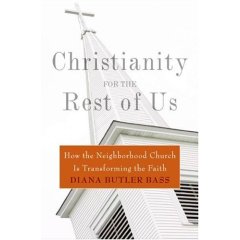
Christianity for the Rest of Us


I have just started a new book, Christianity for the Rest of Us by author and scholar Diana Butler Bass. Diana's book offers hope to neighborhood churches everywhere and points the way toward healthy, vibrant, faithful Christian community. As a young adult, I yearn for a Christianity that is rooted in tradition, yet filled with the Spirit of the living God --- a Christianity that is aware and responsive to the needs, concerns and hopes of this aching planet. Diana shares real stories from real churches all around the country seeking to live the gospel way of life --- feeding, forgiving, healing, reconciling and transforming.

For three years Diana studied centrist and progressive churches and discovered many that are "flourishing, and they are doing so without resorting to mimicking the mega-church, evangelical style." Paraphrasing one commentator, it may just be that the church so many are yearning for is just around the corner. God grants us wisdom and courage through the words of this fellow pilgrim. Here's a glimpse inside Diana's book,

"On my journey, I traveled with those who are more comfortable in the wilderness, people who were willing to explore the new terrain around them. Yet they did not travel alone. I found that in the breakdown of old villages, Christians are forming a different sort of village in congregations cross the country. Not spiritual gated communities or protected rural villages. Rather, their new kind of village is a pilgrim community embarked on a journey of rediscovering Christianity, where people can forge new faith ties in a frightening and fragmented world. For those I met, change was not always easy, and their churches were not perfect. But they embodied courage, creativity, and imagination. And risk. In reaching toward a new kind of Christianity (which is, as I hope will become obvious, actually an old kind of Christianity), they serve as a living guidebook for spiritual nomads who are seeking to find wisdom's way." Christianity for the Rest of Us, pg. 25

Monday, September 25, 2006

Methodists Against the War

In case one needed yet another reason to stand against the war in Iraq, yesterday's story about the Iraq War increasing global terrorism ought to help.

Here's an inspiring story about our Methodist brothers and sisters. I will be joining other Christians and people of faith tomorrow in a peace procession, come along.

Published on Monday, September 25, 2006 by Ekklesia / UK
Bush's Church Urges Pull-out of US Troops from Iraq
by Peter Spiegel
http://www.commondreams.org/headlines06/0925-07.htm

Methodists protest Iraq war
ReligionAndSpirituality.com
http://declarationofpeace.org/published/methodists-protest-iraq-war

WASHINGTON, September 22 (UPI) United Methodist Church leaders have helped launch a week of protest and civil disobedience against the war in Iraq.

The Declaration of Peace, signed Thursday, is described as a call for nonviolent action to end the war in Iraq, United Methodist News Service reported Friday. The Washington event was one of 350 that will be staged nationwide to promote the peace initiative. The declaration calls for people to “engage in peaceful protests” if there is not a plan for troop withdrawal established and begun by Sept. 21, days before Congress adjourns for the fall elections.

More than 500 groups, almost half of them faith organizations, are involved in the declaration of peace effort, which recently retired Bishop Susan Morrison said includes “acts of moral witness to seek a new course for our country.”

By signing the peace document in front of the White House, the United Methodists and other protesters hoped not only to make a statement but also to influence congressional races in November by forcing candidates to outline where they stand on the war.

Speakers at the Washington rally, which drew about 100 people to Lafayette Square, castigated Bush, accusing him of lying about Iraq possessing weapons of mass destruction and launching what they called an illegal offensive.

“Our demand as a movement is to end the war now,” said Morrison, recently retired episcopal leader of the Troy Annual (regional) Conference.

The declaration calls the situation in Iraq “the U.S. war in Iraq” and describes it as “an endless fire consuming lives, resources and the fragile possibilities of peace.”

Thirty-four protesters, attempting to deliver the peace statement to Bush in an act of civil disobedience, were arrested and charged with disorderly conduct. None of the United Methodist protesters participated in that portion of the day’s activity.

The Declaration of Peace initiative provides a way for the faithful to vent their anger about Iraq, Morrison said. “There are a lot of frustrated United Methodists out there who don’t know where to channel it,” she said.

United Methodist clergywomen attending the recent 2006 International Clergywomen’s Consultation in Chicago signed the declaration to “call to end this war” and made a commitment to take action to translate the call into a concrete plan for peace.

Jim Winkler, top executive of the United Methodist Board of Church and Society, said that protesting the war is similar to the church’s work to promote other social movements. The church took prophetic positions on civil rights, women’s rights and nuclear disarmament before Congress acted, he noted.

“It has taken time for Congress to catch up,” Winkler said. “We may be seeing another example of that.”

Staff members of the denomination’s social advocacy agency have been meeting with congressional staff members on a weekly basis regarding policy toward Iraq. Political leaders on Capitol Hill have been divided on the Bush administration’s policy, with some calling for a timetable for withdrawal and others urging a staying of the course.

“You see more and more Republicans who are uncomfortable with the position of ‘stay the course,’” said Mark Harrison, director of the board’s Peace with Justice program.
But the White House asserts that Iraq would collapse if U.S. troops leave prematurely, potentially leading to a full-blown civil war.

United Methodist leaders argue that the long insurgency in Iraq, which has resulted in the deaths of thousands Americans and Iraqis, is proof that U.S. involvement is misguided.
“Iraq is in a civil war right now because we’re there,” Winkler said.

Morrison agreed. “We just exacerbate what’s going on.” She disputed critics who say that war protesters undermine U.S. troops and sap their morale.

“We care deeply about the troops,” she said. “We’re proud of their commitment. We want them safe. We want them home.”

Within individual United Methodist congregations, however, members may not agree with the way the anti-war movement is articulating its opposition.

Differences of opinion must be respected, said the Rev. Dean Snyder, senior minister of Foundry United Methodist Church in Washington. Such divisions have come up throughout Christian history.

“It’s part of our discernment process of truth,” he said. “But that does not change the fact that church leaders are put in positions of prophetic responsibility.”
Friday, September 22, 2006

Progressive Evangelicals

I've been commenting occassionally on the God's Politics Blog, an exciting new blog for Christians to discuss faith and politics led by Jim Wallis and Sojourners. Wallis and Sojourners are doing so much to help end the monologue of the religious right. Here's my latest comment with links to more information. You can watch the segment on YouTube.

I am so grateful that Jim Wallis and Sojourners are getting wider exposure. The segment on the CBS Evening News last night was just that, a segment. I thought Jim sounded strong and inviting. Let's make sure that this kind of coverage of evangelical progressives continues -- and that more progressive Christian voices are amplified in the press such as Diana Butler Bass, Shane Claiborne, Brian McLaren, Alan Jones, Michael Battle, Sister Helen Prejean, Desmond Tutu and Ched Myers.

For the monologue to be over -- we all need to speak up online, in our churches, and in our communities. There are many people especially in rural America (I was born and raised in the Shenandoah Valley of Virginia) who don't realize that there are progressive evangelical Christians. So even short segments in the media like the one last night make a difference.

There have been progressive Christians throughout history --- St. Francis of Assisi was hardly a hard-hearted conservative, nor was Dorothy Day in the 20th century. St. Francis was a pacifist who refused to support the crusades and went on a peace mission to meet with the "enemy." Dorothy Day was a strong supporter of worker rights and critic of the military industrial complex. Both were sincere Christians who believed in the Bible, in the creeds, and believed that Jesus wanted followers of his way of life not just worshippers.

Also Democrats have spoken about their faith and how it shapes public policy for a long time. Robert F. Kennedy was very articulate about how faith called us to care for the least of these. FDR's New Deal was organized by people of faith like Episcopalian Frances Perkins, also the first woman on a president's cabinet. Former Secretary of State Madeleine Albright recently spoke about her faith at Virginia Theological Seminary and has written a book about faith and politics. We progressive Christians need to remember our history and our heros -- the Saints of God who have spoken out in every generation for justice, peace and human dignity.